 Pin
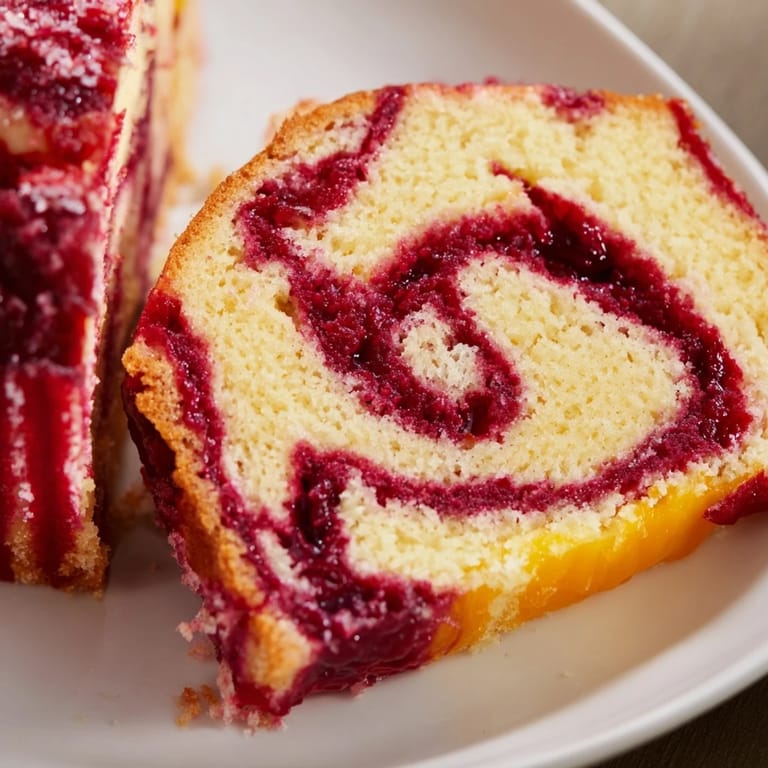
Pin I still remember the December morning I discovered that the most showstopping dessert doesn't need to be complicated—just dramatic. A friend brought over a sliced loaf cake with these stunning ribbons of crimson and orange spiraling through it, and I was completely mesmerized. She told me it was her cranberry orange swirl, and after one bite of that tender crumb with bursts of tart berry and bright citrus, I knew I had to learn her secrets. Now, every holiday season, I find myself drawn back to making this cake, not just because it's beautiful, but because it feels like edible joy.
I'll never forget making this for my partner's family dinner, watching my usually skeptical father-in-law take his first bite and then immediately ask for seconds. That's when I knew this recipe had something special—it speaks a language everyone understands, where beautiful and delicious aren't separate things but the same promise kept.
Ingredients
- Fresh or frozen cranberries (1½ cups): Use whatever you have on hand—frozen cranberries work just as beautifully as fresh and don't need thawing. They'll burst with heat and release their gorgeous deep red juice, which is exactly what you're after.
- Granulated sugar (½ cup for cranberries, ½ cup for orange, 1 cup for cake): Sugar is the bridge between tart and balanced; it coaxes out the cranberries' complexity while letting the orange shine.
- Water (2 tbsp): Just enough to get the cranberries started before they release their own liquid.
- Orange zest (½ tsp for cranberries, 1 tbsp for orange swirl): Use organic oranges if you can, and zest before you juice—it's a small detail that makes an enormous difference in brightness.
- Freshly squeezed orange juice (¾ cup): Bottled will work in a pinch, but fresh juice has a delicate floral quality that really elevates the swirl from good to memorable.
- Cornstarch (1 tbsp): This does the heavy lifting in thickening your orange swirl to the perfect consistency, so it holds its shape instead of bleeding everywhere.
- All-purpose flour (2 cups): The foundation of your cake—measure by spooning into a measuring cup and leveling, never scooping straight from the bag, which compacts the flour.
- Baking powder and baking soda (1½ tsp and ½ tsp): Together, they give the cake its tender crumb and that subtle rise that makes each bite feel light.
- Fine sea salt (½ tsp): A whisper of salt that makes everything taste more like itself, especially important when balancing sweet and tart.
- Unsalted butter (½ cup, softened): Softened butter creams beautifully into sugar, trapping tiny air bubbles that make the cake tender—this is why room temperature matters.
- Eggs (2 large, room temperature): Cold eggs won't emulsify properly with the butter and sugar, resulting in a dense cake; let them sit out for 15 minutes beforehand.
- Pure vanilla extract (1 tsp): The quiet note that ties everything together without announcing itself.
- Whole milk (1 cup, room temperature): Just like the eggs, cold milk can seize the batter; let it warm slightly for a smoother batter.
Tired of Takeout? 🥡
Get 10 meals you can make faster than delivery arrives. Seriously.
One email. No spam. Unsubscribe anytime.
Instructions
- Make your cranberry base:
- Pour the cranberries, sugar, and water into a small saucepan and set it over medium heat. You'll hear them start to pop and crackle—that's music to a baker's ears. Let them simmer for about 7 to 10 minutes, stirring now and then, until the berries have burst and the mixture looks like a deep burgundy jam. When you drag a spoon across the bottom of the pan, it should leave a clear trail that doesn't immediately fill back in. Stir in your orange zest and let it cook for another 3 to 5 minutes until it's glossy and thick. The whole kitchen will smell like Christmas. Pour it onto a plate or into a bowl and let it cool completely—this is important, because warm swirl will melt into your batter and muddy the pattern.
- Create your orange swirl:
- In another small saucepan, whisk together the fresh orange juice, sugar, orange zest, and cornstarch until there are no lumpy bits. Set it over medium-low heat and keep stirring—this is not the time to walk away. After a few minutes, you'll feel it thicken under your whisk, like it's waking up. When it coats the back of a spoon and looks glossy and vibrant, you're done. The color should be a beautiful, bright golden-orange. Let it cool completely; if you try to swirl it while it's warm, it'll run right through your batter like watercolor paint in rain.
- Prepare your cake batter:
- Preheat your oven to 350°F and get your 9-inch loaf pan ready—grease it well and line it with parchment paper so the ends overhang slightly, which makes lifting out the finished cake effortless. In a medium bowl, whisk together the flour, baking powder, baking soda, and salt. Set that aside. In a larger bowl, beat your softened butter and sugar together on medium speed for 3 to 4 minutes. You're looking for something pale, fluffy, and almost cloud-like—this is where your cake gets its tender crumb. Add your eggs one at a time, beating well after each one and scraping down the sides of the bowl so everything incorporates evenly. Mix in your vanilla extract. Now, here's where patience matters: with your mixer on low speed, add the flour mixture in three separate additions, alternating with your milk (flour, milk, flour, milk, flour). After each addition, mix only until you just can't see dry flour anymore—overmixing develops gluten, which makes the cake tough and dense. Your finished batter should be thick, smooth, and pale yellow.
- Assemble the marbled masterpiece:
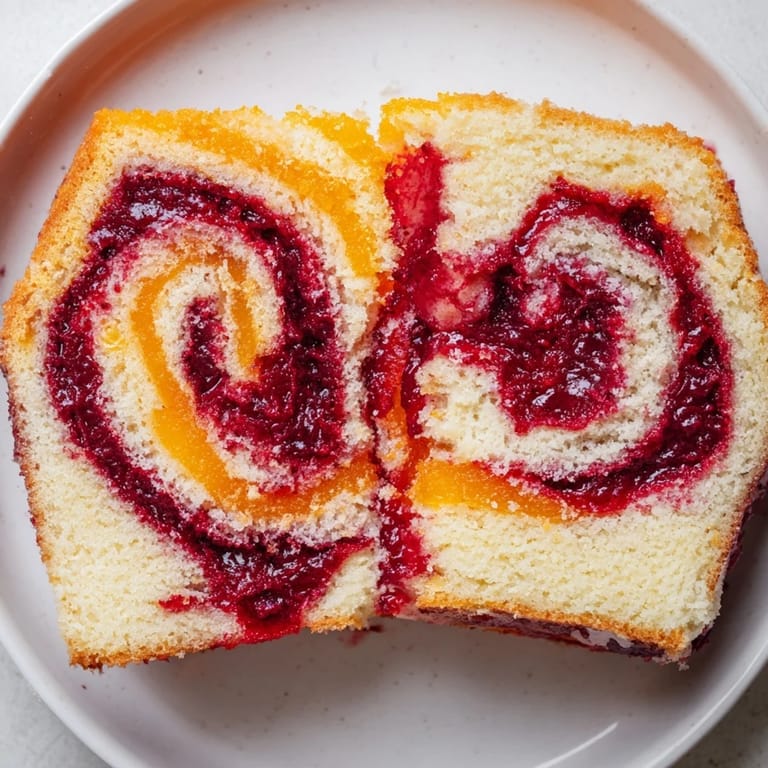
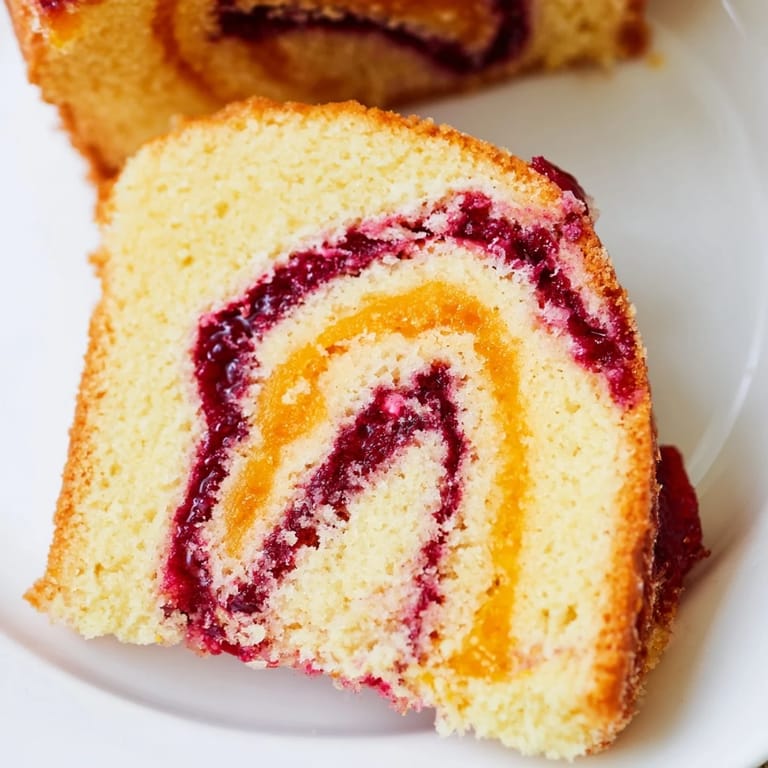
- Spoon about one-third of your batter into the prepared pan and smooth it into an even layer. Now comes the fun part: dollop half of your cranberry swirl and half of your orange swirl in alternating spoonfuls over that batter layer. Take a thin skewer or butter knife and gently drag it through the batter in loose, spiral motions—imagine you're creating a natural, organic pattern, not something perfectly geometric. Don't over-swirl or your beautiful red and orange will merge into a muddy brown. Spoon in another third of batter, then repeat the swirl process with the remaining fruit purees, and finish with your last bit of batter on top. For the final layer, create that dramatic spiral pattern that will be visible on the sides of the loaf when you slice it. You should see distinct ribbons of deep red and bright orange threading through the pale cake.
- Let it bake to golden perfection:
- Place your pan in the center of the oven and bake for 50 to 60 minutes. You're looking for a golden top, edges that have pulled slightly away from the pan, and that unmistakable citrusy, vanilla-scented aroma filling your kitchen. To check for doneness, insert a toothpick in the center—it should come out clean or with just a few moist crumbs clinging to it. If the top is browning too quickly, tent it loosely with foil after about 35 minutes. The cake is done when it looks set and feels springy when you gently press the top.
- Cool with patience and care:
- Let the cake rest in the pan on a wire rack for 15 minutes—this gives the structure time to firm up. Then use that parchment overhang to lift the whole cake out onto the rack to cool completely. This step is crucial for clean, beautiful slices with defined swirls. Once it's fully cooled, use a sharp, serrated knife to slice, wiping the knife clean between cuts for those Instagram-worthy presentations. The swirls will be stunning and distinct.
 Pin
Pin There's a moment that happens every time I make this cake—usually around when I'm lifting it out of the pan to cool—where I feel this little spark of pride. It's a cake that looks like it took hours and complicated skills, but really, it just took patience and the willingness to let fruit purees be themselves. That's when I realized that beautiful food doesn't have to be fussy; it just has to be thoughtful.
The Story Behind the Swirls
Marbled cakes have been around for centuries, but this particular combination—cranberry and orange—feels quintessentially modern and seasonal. It's the kind of dessert that bridges the gap between traditional and unexpected, which is probably why it stopped people mid-bite in my kitchen. The cranberry brings that slightly tart, earthy note, while the orange adds brightness and a whisper of sophistication. Together, they're the kind of flavor pairing that makes people say, 'I don't know what this is, but I love it.' That's the goal of any really good dessert, isn't it?
Why This Cake Holds Its Shape
One of the reasons I keep coming back to this recipe is that the loaf pan creates natural structure—the straight sides mean your swirls show beautifully on every slice, and the smaller shape means even distribution of heat. The cornstarch in the orange swirl and the natural pectin in the cooked cranberries both help stabilize the fillings so they don't run everywhere. It's engineering disguised as cooking.
Storage and Make-Ahead Magic
This cake is wonderfully forgiving for entertaining because it actually tastes better the next day—the flavors meld and the crumb sets up more firmly, making slicing even easier. Store it wrapped tightly at room temperature for up to 2 days, or refrigerate it for up to 5 days if you want it to last longer. You can also freeze individual slices wrapped in plastic wrap and parchment for up to 2 months; just thaw them at room temperature for a couple of hours. If you want to reheat a slice, a gentle 10 to 15 seconds in the microwave or a few minutes in a 300°F oven will warm it without drying it out. For gluten-free bakers, simply swap in a 1:1 gluten-free flour blend and the cake performs beautifully. And if you ever want to try a different citrus, lemon works absolutely wonderfully for a tangier version—the brightness is still there, just with more edge.
- The fruit purees must be completely cool before swirling, or they'll bleed and muddy the colors.
- Always use a serrated knife and wipe it clean between slices for the most beautiful presentation.
- Let the cake cool completely before slicing to ensure those swirls stay distinct and gorgeous.
 Pin
Pin This is the kind of cake I make when I want to say something without words—when I want to show someone they're worth the time and care that goes into making something beautiful. One slice, and you'll understand why it's become my favorite dessert to give.
Recipe Questions
- → How do I prevent the swirls from blending too much?
Gently swirl the fillings with a skewer without over-mixing to keep distinct spiral patterns. Avoid excessive stirring.
- → Can I use frozen cranberries for the swirl?
Yes, frozen cranberries can be used directly without thawing to maintain intensity and consistency.
- → What causes a runny swirl, and how to fix it?
Under-cooking the fruit purees causes runny swirls. Simmer until thick and glossy for the right texture.
- → How should I reheat slices without drying them out?
Warm gently in a microwave or oven, avoiding high heat to keep the cake moist.
- → Is it possible to make this dairy-free or gluten-free?
Use a gluten-free flour blend and plant-based milk alternative to adapt for dietary needs.